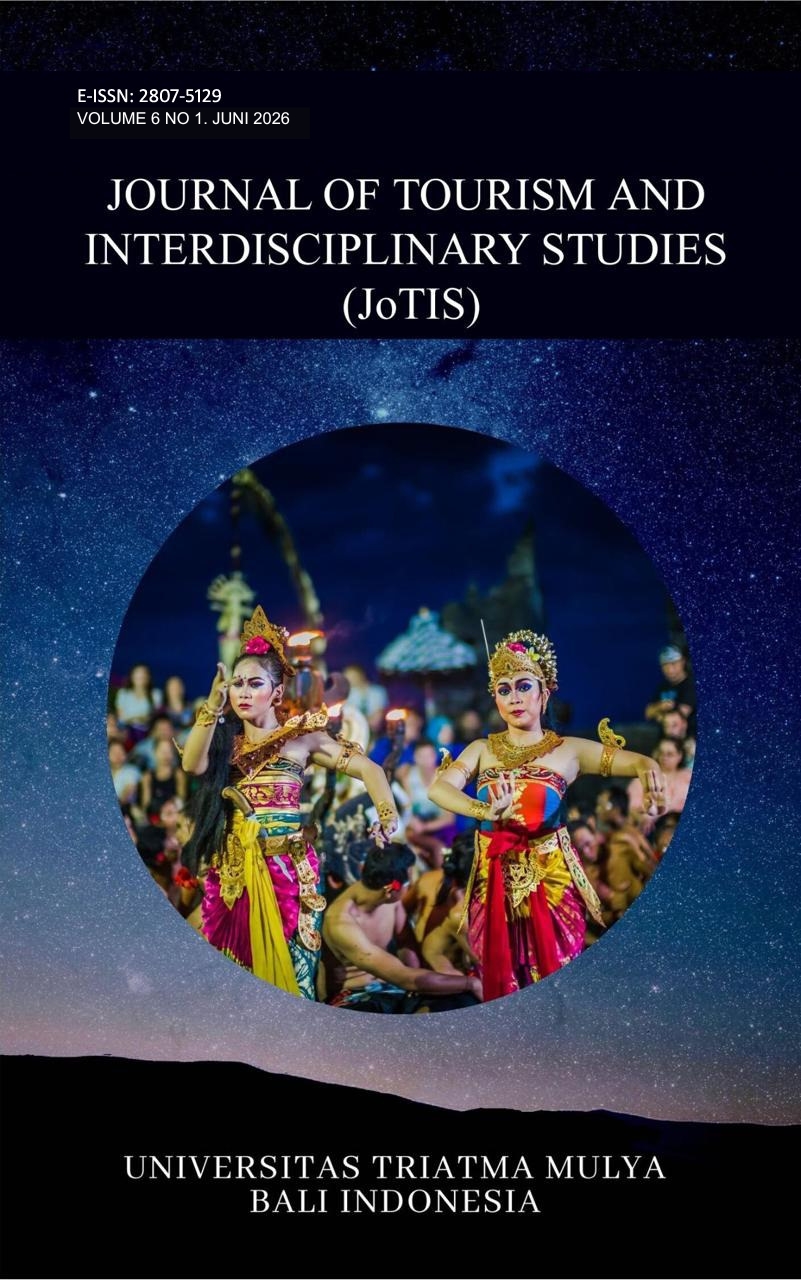
Analisis Potensi Pariwisata Budaya pada Goa Gajah di Gianyar: Studi Kasus Aspek Sejarah, Sosial dan Budaya
DOI:
https://doi.org/10.51713/jotis.2026.61125Keywords:
goa gajah, cultural tourism, historical syncretism, collaborative governanceAbstract
This study analyzes the cultural tourism potential of Goa Gajah in Gianyar, Bali, based on historical, social, and cultural aspects. While the research background highlights the threat of commercialization to the site's spiritual value, this study identifies a research gap in the lack of sustainable tourism studies that fully integrate socio-cultural aspects. Problems in the field include physical damage to facilities, spatial conflicts, and low participation from the local community. Employing a qualitative descriptive approach through an intrinsic case study method, this research aims to formulate strategies for optimizing this potential without compromising the site's intrinsic value. Utilizing theories of cultural tourism and heritage values, data were collected through field observations, in-depth interviews, and documentation studies. The findings indicate that the primary potential of Goa Gajah stems from the unique historical syncretism of Shiva-Buddha, social interactions, and the preservation of local rituals. Development strategies include the implementation of conservation zoning, digital interpretation, and collaborative governance. The theoretical benefit of this research enriches the literature on history-based tourism, while its practical benefit provides policy recommendations for managers to achieve a balance between cultural site preservation and the economic welfare improvement of the surrounding community.
Downloads
References
Ardika, I. W. 2003. Bali: Balinese culture and tourism. Udayana University Press.
Ardika, I. W. 2015. Archaeology, cultural heritage and tourism in Bali. Udayana Publishing House.
Ardika, I. W. 2018. Cagar budaya dan pariwisata berkelanjutan di Indonesia. Kementerian Kebudayaan Indonesia.
Ardika, I. W., Muliarsa, I. W., Srijaya, I. W., Sepur, I W. S., Sumartika, I. N., Bagus G. A. A., Rena, I. G. M. (2010). Pura Pegulingan, Tirtha Empul, dan Goa Gajah: Peninggalan purbakala di daerah aliran Sungai Pakerisan dan Petanu Gianyar. Direktorat Jenderal Kebudayaan Bali.
Balai Pelestarian Cagar Budaya (BPCB) Bali. 2018. Laporan pemugaran dan penataan kawasan cagar budaya Goa Gajah pasca gempa 2017. BPCB Bali.
Feilden, B. M., & Jokilehto, J. 1998. Management guidelines for world cultural heritage sites (2nd ed.). ICCROM.
Geriya, I. W. 2000. Transformasi kebudayaan Bali: Memasuki abad XXI. Upada Sastra.
Gunawan, I., & Pitana, I. G. 2019. Konservasi situs cagar budaya berbasis kearifan lokal: Studi kasus di kawasan Goa Gajah, Gianyar. Jurnal Kajian Bali, 9(2), 405–426.
Kementerian Pendidikan dan Kebudayaan Republik Indonesia. 2006. Warisan budaya tak benda dan pembangunan berkelanjutan. https://ich.unesco.org/doc/src/34299-ID.pdf
Kempers, A. J. B. 1991. Monumental Bali: Introduction to Balinese archaeology & guide to the monuments. Periplus Editions.
McKercher, B., & Du Cros, H. 2002. Cultural tourism: The partnership between tourism and cultural heritage management. Routledge.
Miles, M. B., Huberman, A. M., & Saldana, J. 2014. Qualitative data analysis: A methods sourcebook (3rd ed.). Sage Publications.
Novera, L., Bawono, R. A., & Jaya, S. 2024. Konsep tata ruang Goa Gajah dan Kolam Patirthan berdasarkan arsitektur tradisional Bali. Jurnal Syntax Admiration, 5(10), 3804–3818.
Picard, M. 1992. Bali: Tourisme culturel et culture touristique. L’Harmattan. (Diterjemahkan ke dalam bahasa Indonesia oleh Kepustakaan Populer Gramedia, 2006).
Picard, M. 1996. Bali: Cultural Tourism and Touristic Culture. Archipelago Press.
Pemerintah Kabupaten Gianyar. 2021. Rencana induk pembangunan kepariwisataan daerah (RIPPDA) Kabupaten Gianyar 2021–2026. Dinas Pariwisata Kabupaten Gianyar.
Pramartha, B., & Parwati, Y. 2023. Situs Goa Gajah sebagai sumber pembelajaran sejarah Bali. Jurnal Nirwasita, 4(1), 24–29.
Putra, G. A. I. G. 1977. The Elephant Cave Goa Gajah Bali. Yayasan Kanisius.
Stake, R. E. 1995. The Art of Case Study Research. Sage Publications.
Stake, R. E. 2010.Qualitative Research: Studying How Things Work. Guilford Press.
Stutterheim, W. F. 1929. Oudheden Van Bali (Antiquities of Bali). Kirtya Liefrinck-van der Tuuk.
Sugiyono. 2021. Metode Penelitian Kuantitatif, Kualitatif, dan R&D (Cetakan ke-3). Alfabeta.
Sugiyono. 2022. Metode Penelitian Kualitatif (Untuk penelitian yang bersifat: eksploratif, interpretatif, interaktif dan konstruktif). Alfabeta.
Timothy, D. J., & Boyd, S. W. 2003. Heritage Tourism. Prentice Hall.
UNESCO World Heritage Centre. 2012. Nomination dossier: The cultural landscape of Bali Province: the Subak system as a manifestation of the Tri Hita Karana philosophy. UNESCO.
Downloads
Published
Issue
Section
License
Copyright (c) 2026 Journal of Tourism and Interdiciplinary Studies

This work is licensed under a Creative Commons Attribution 4.0 International License.

Ciptaan disebarluaskan di bawah Lisensi Creative Commons Atribusi 4.0 Internasional.